



How to Build a Jewelry Stack That Actually Looks Good
How to Build a Jewelry Stack That Actually Looks Good
A good jewelry stack is not an accident. It looks effortless on the wrist, but behind every stack that photographs well, catches light across a dinner table, or makes someone ask where you got it, there is a small set of rules doing quiet work. We have been designing bracelets at Bloom since 2021, and 87 percent of what we sell walks out the door on a wrist. We have opinions.
This is the guide we wish existed when we started. It is not a trend roundup. It is the actual framework our team uses when we style a stack: three textures, one metal story, one statement piece. That is the whole formula. Everything else in this post is how to execute it without looking like you tried too hard. We will cover how many bracelets is the right number, what order to wear them in, how to mix chain weights, when to break the rules, and which Bloom pieces play well with almost anything you already own.
If you are starting from zero, we have you. If you already have a drawer of pieces and nothing feels right together, we really have you.
What makes a jewelry stack actually look good?
A jewelry stack looks good when it has three different textures, one consistent metal tone, and one clear statement piece that anchors the rest.
That is the formula. Three textures, one metal story, one statement. Read it twice. It sounds too simple until you try it on and realize every stack you have ever loved followed that math, and every one that felt off broke at least one of those rules.
Texture is what makes a stack feel collected instead of matched. When every bracelet is the same thickness and finish, the stack flattens out and reads like a set. When you layer three distinct textures, say a smooth polished chain, a pavé stone piece, and a charm or motif bracelet, light hits each piece differently and the stack reads as styled. Your eye has somewhere to rest and somewhere to travel.
Metal story is the glue. You do not need to commit to one metal for life, but within a single stack, pick a lane. All gold, all silver, or an intentional gold-and-silver mix where at least one piece bridges the two. A lonely silver bracelet dropped into an all-gold stack almost never works. A stack that is deliberately half and half, with a two-tone bracelet in the middle to tie it together, almost always does.
The statement piece is the one bracelet people ask about. It is usually the piece with color, with a clear motif, or with the most visual weight. Everything else in the stack is supporting cast. If two pieces are fighting to be the star, the stack loses. Pick your lead and let the others hold space.
How many bracelets should you stack?
Three bracelets is the sweet spot for a jewelry stack, with two being the most wearable everyday option and four being the upper limit before a stack starts to feel costume.
We get asked this constantly, and the honest answer is that the number depends on your wrist size and the weight of the pieces. A seven-inch wrist wearing three delicate chain bracelets will look light and pretty. A six-inch wrist wearing three thick bangles will look overwhelmed. The bracelet does not care about your intent, only your proportions.
For most people, two bracelets is the everyday baseline. A simple chain plus one piece with a little more personality. You can wear it to work, to the gym, to sleep, and never think about it again. This is the stack you build around. Three bracelets is the styled version of that same wrist. You are adding one more texture or one more pop of color and the stack goes from present to intentional.
Four bracelets is where it gets advanced. At four, you have to be strict about spacing and weight. No two pieces that are the same chain type should sit next to each other. Your statement piece should be in the middle, not on the end. And at least one of the four should be small enough that it almost disappears, acting as a palate cleanser between the louder pieces.
Five or more is editorial. It can be stunning in a photograph and exhausting to wear. We do not recommend it for daily life unless at least three of the pieces are permanent or semi-permanent and live on the wrist.
What are the best bracelet stack combinations?
The six best bracelet stack combinations in 2026 are The Everyday Two, The Everyday Three, The Color Story, The Romantic, The Celestial, and The Statement One, each built from Bloom pieces and all following the three-texture rule anchored on a single statement piece.
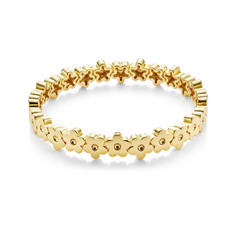
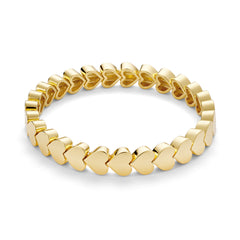
- Bloom. The Everyday Two: Classic Flower + Heart Bracelet ($176 total). 18k gold-plated brass, adjustable stretch. Starter stack. Two motifs, one metal, zero effort. Wears well to work, to dinner, to sleep. View
- Bloom. The Everyday Three: Classic Flower + Pavé Emerald + Heart ($304 total). 18k gold-plated, emerald pavé accent. The full three-texture formula. Motif, stone, motif. Emerald is the statement, flowers hold the frame. View
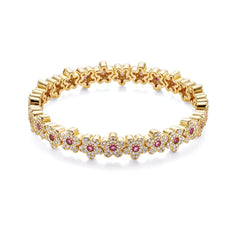
- Bloom. The Color Story: Pavé Emerald + Pavé Ruby + Classic Flower ($344 total). 18k gold-plated, emerald and ruby pavé. Advanced. Two stones in the same motif family with a plain flower in the middle to keep the eye calm. View
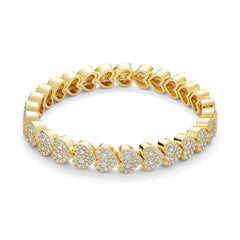
- Bloom. The Romantic: Pavé Heart + Classic Flower ($216 total). 18k gold-plated with pavé. Soft and personal. The pavé heart carries the shine, the flower grounds it. A great gift-stack. View
- Bloom. The Celestial: Seeing Stars + Heart + Classic Flower ($306 total). 18k gold-plated. Motif mix that reads as a little story on the wrist. Stars, hearts, flowers. Works under a cuff of a sleeve. View
- Bloom. The Statement One: Seeing Stars Bracelet solo ($130). 18k gold-plated. The stack of one. When the piece does enough work on its own. Pair with a watch and call it done. View
How do you mix metals in a bracelet stack?
Mixing metals in a bracelet stack works when at least one piece in the stack contains both metals, acting as a visual bridge between the tones.
Most stacks fail at metal mixing because they treat gold and silver like they can be tossed together and left to figure it out. They cannot. Your eye reads a random gold bracelet next to a random silver bracelet as a mistake, even when the pieces are beautiful on their own. The fix is a bridge.
A bridge piece is any bracelet that contains both metals in the same design, whether through a two-tone chain, a mixed-metal charm, or a stone setting in one metal on a chain in the other. That single piece gives your eye permission to accept the rest of the mix as intentional. Without it, you are asking the viewer to do styling work that belongs to you.
If you do not own a bridge piece, the cleanest move is to commit to one metal per stack and save the other metal for a different outfit, a different wrist, or a different day. Gold on the right wrist, silver on the left is a valid choice. Gold and silver fighting on the same wrist without a bridge is not.
For Bloom specifically, we lean gold. All of our bracelets sit in the gold family, which means building a Bloom stack does the metal-story work for you automatically. This is not an accident. It is why our pieces layer so easily with each other.
What order should you stack bracelets in?
Bracelets stack best when the statement piece sits in the middle of your wrist and the quieter pieces frame it on either side, so the strongest design lands where your wrist is widest.
Most people put their favorite piece on the outside of the stack, closest to their hand. That is backwards. The middle of your wrist is the widest, flattest part, and it is what people see when you rest your hand on a table, hold a coffee, or gesture while you talk. Put your best piece there.
On either side of the statement, alternate weights. If your statement is a pavé piece, frame it with a plain chain on one side and a charm or motif piece on the other. If your statement is a charm bracelet, frame it with two simpler chains of different weights. The goal is to keep any two similar pieces from touching.
If you wear a watch, the watch is the statement. Everything else on that wrist is supporting cast, and the stack should get smaller and simpler as it moves away from the watch face. Do not compete with a watch. Frame it.
And if you wear bracelets on both wrists, keep the dominant stack on your non-dominant hand. You will notice it less, and it will take less physical abuse through the day.
Can you wear the same bracelet every day?
Yes, a well-made gold-plated bracelet can be worn every day if you follow basic care, and a daily anchor bracelet is actually the smartest foundation for a long-term stack.
Every good stack starts with a daily anchor. One bracelet that lives on your wrist, that you shower in, sleep in, and stop noticing. For a lot of Bloom customers, that is the Classic Flower Bracelet or the Heart Bracelet. Neither is delicate enough to baby, both are light enough to forget.
Daily-wear jewelry lasts longer than you think if you keep it out of three things: chlorine, hairspray, and thick lotions. Water alone is fine. Sweat is fine. Soap in the shower is fine. It is the pool and the beauty aisle that shorten a plating's life, not normal daily activity.
Once your daily anchor is in place, everything else in your stack becomes a swap. You add one or two pieces for the day, take them off at night, and the anchor stays. This is why the three-texture formula works so well. Your anchor is texture one. You are only choosing textures two and three each morning, which is a three-second decision.
What are the biggest mistakes people make when stacking jewelry?
The five biggest jewelry stacking mistakes are matching instead of mixing, too many statement pieces in one stack, ignoring wrist proportion, never rotating the pieces, and buying the wrong size.
Mistake one: buying a matched set and wearing all the pieces together. Matched sets are designed to be broken up. Wear the bracelet from set A with the bracelet from set B and suddenly both look more expensive. Sets sold as sets and worn as sets read as costume.
Mistake two: letting every piece shout. If your charm bracelet, your pavé stone, and your chunky chain are all in the same stack, there is no star. The eye has nowhere to land. Pick one lead per stack and demote the rest.
Mistake three: ignoring your actual wrist. A six-inch wrist and an eight-inch wrist cannot wear the same stack. Smaller wrists do better with thinner chains and fewer pieces. Larger wrists can carry weight and should. This is not a rule about your body, it is a rule about proportion.
Mistake four: never taking the stack off. A stack that never changes stops being a stack and starts being a uniform. Rotate. Swap one piece a week. Your stack should evolve the way your wardrobe does.
Mistake five: buying the wrong size. A bracelet that slides past the wrist bone is too big, and it will never sit right in a stack no matter how beautiful the piece is. Fit first, design second.
How do you build a jewelry stack on a budget?
The best way to build a jewelry stack on a budget is to start with one $88 to $130 anchor bracelet, add one stone piece under $130 as your statement, and stop there until you have worn the pair long enough to know what you actually reach for.
Most people overbuy at the start. They pick up five pieces at once, try to style them all at the same time, and end up wearing two and regretting the other three. The cheaper path, both financially and stylistically, is to buy slower.
Start with an anchor. The Classic Flower Bracelet at $88 or the Heart Bracelet at $88 are both built for this job. Wear the anchor alone for two weeks. You will learn what you like about it and what is missing. That missing piece is your second buy.
For most people, the second piece is a stone. The Pavé Flower Bracelet in Emerald or Ruby at $128 gives you color, shine, and a clear statement in one purchase. Two bracelets, under $220, and you have a complete stack that follows every rule in this guide.
The third piece, when you are ready, is the one that expresses something specific to you. For some customers that is the Seeing Stars Bracelet at $130. For others it is the Pavé Heart Bracelet at $128. There is no correct third piece. There is only the piece that finishes the stack that feels like yours.
A great stack is three textures, one metal story, one statement piece, and the quiet confidence to stop adding once it looks right.

Frequently Asked
Shop the Collection


Recommended Reading


Join the Bloom Journal
Get expert styling tips, care guides, and first access to new collections delivered to your inbox.