



How Long Does Gold-Plated Jewelry Actually Last?
How Long Does Gold-Plated Jewelry Last?
Most articles on this topic give you a corporate FAQ answer. We've been designing and selling gold-plated jewelry for four years, running Bloom out of Miami. Here's the honest version.
The short answer: with regular wear and average care, gold-plated jewelry lasts between 1 and 2 years before the plating starts to show its age. With thicker plating and good habits, 3 years is realistic. With daily exposure to perfume, chlorine, or hot showers, 6 months is the bleak but truthful number.
Here's what actually determines how long your pieces hold, what you can do to extend them, and how gold-plated stacks up against vermeil and solid gold so you buy the right thing for the way you actually wear jewelry.
The range matters because "gold-plated" isn't one thing. Industry-minimum plating is around 0.5 microns thick, which on a ring or bracelet you wear every day might hold color for 6 to 9 months. Better pieces come in at 1.5 to 2.5 microns, which is a meaningful jump and why well-made gold-plated from a brand that actually cares about craft can last closer to 2 years before needing replating or retirement.
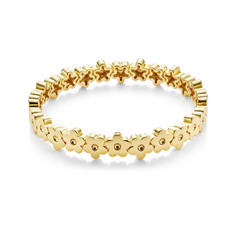
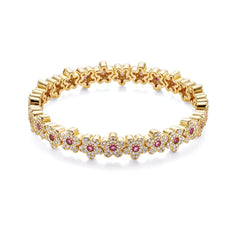
Bloom plates our pieces at roughly twice the industry-minimum thickness. We also use high-quality brass as our base metal, not the cheap zinc alloy some fast-jewelry brands default to. That combination is why our Classic Flower Bracelet and the Pavé Flower Bracelet collection tend to hold color longer than customers expect for the price point.
Gold-plated is a category, not a quality tier. It's the right choice for specific use cases, which we'll get to in a minute. But if someone tells you gold-plated is "cheap jewelry" and that's that, they're being reductive. The craft of the plating, the core metal, and the design intent all matter.
What Makes Gold-Plated Jewelry Wear Down?
Plating wears down when the thin gold layer on top gets chemically broken or physically abraded, specifically from lotion, perfume, chlorine, saltwater, sweat, and friction against other jewelry or hard surfaces.
Here's the thing nobody tells you about gold-plating: it's not actually the gold that fails first. Gold is one of the most stable metals on earth. What fails is the bond between the gold layer and the base metal underneath, which breaks down chemically when exposed to:
- Chlorine (pools, hot tubs, some tap water in older buildings). The single worst offender. One swim with untreated gold-plated pieces can cut lifespan in half.
- Perfume and alcohol-based products. Spray perfume on your wrist, then put the bracelet on, and you've started a slow corrosion process underneath the plating.
- Lotion and sunscreen. Same issue as perfume, worse because people keep reapplying throughout the day.
- Hot water and steam. Showers, saunas, hot yoga, dishwashing. Heat expands metal microscopically, and repeated cycles break the plating bond.
- Friction. Stacking rings that click against each other all day, bracelets that slide against a watch, necklaces that knot against each other. Mechanical wear is slower than chemical wear but real.
The counterintuitive part: daily wear is actually better for gold-plated than occasional wear. Your skin's natural oils condition the plating. Pieces stored for months in a humid drawer oxidize faster than pieces worn daily in Miami's heat and humidity.
How to Make It Last Longer
Three habits roughly double the lifespan of gold-plated jewelry: apply lotion and perfume before putting your jewelry on, remove your jewelry before showering or swimming, and store pieces flat in a dry, lined box between wears.
The rule we share with every Bloom customer is "last on, first off." Get ready in your usual order. Do your skincare, your lotion, your perfume, your hair. Then put your jewelry on as the last step. When you're undressing at night, take the jewelry off before you wash your face or shower. That single habit is the difference between a bracelet lasting a year and lasting three.
"Last on, first off. That single habit is the difference between a bracelet lasting a year and lasting three."
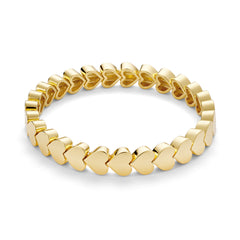
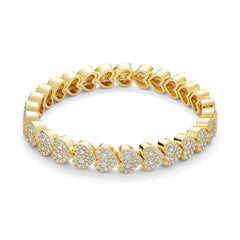
This is also one of the reasons Bloom bracelets are built with a stretch band instead of a clasp. You can slip them on and off in a second with one hand, which makes the habit a lot easier to actually follow. Small design decision, real impact on how long the piece holds up.
A few more specifics that compound:
Cleaning. Soft lint-free cloth, lukewarm water, a tiny drop of gentle hand soap if there's visible buildup. Rinse fully. Dry immediately with a second cloth. Never use silver polish, baking soda, toothpaste, or ultrasonic cleaners on gold-plated pieces. They strip the plating directly.
Storage. Flat, individual, dry, dark. Not in a humid bathroom. Not piled in a bowl where pieces rub against each other. A small fabric-lined jewelry box or individual pouches works. The goal is no friction, no moisture, no air exposure.
The hot list. Remove gold-plated before: showering, swimming, hot yoga, saunas, sleep (optional but helpful), intense workouts with heavy sweating, and any beauty treatments involving chemicals.
The skin-chemistry note. Some people's body chemistry tarnishes everything faster. Higher acidity, certain medications, pregnancy, hormonal shifts. If your gold-plated pieces wear faster than your friend's, it's biology, not the jewelry. You might be a candidate for vermeil or solid gold instead of gold-plated.
Gold-Plated vs Vermeil vs Solid Gold
Gold-plated has a layer of gold (typically 0.5 to 3 microns) over a base metal and lasts 1 to 3 years depending on plating thickness and base metal quality. Gold vermeil has a gold layer of at least 2.5 microns over sterling silver specifically, and typically lasts 3 to 5 years. Solid gold (10k, 14k, 18k) lasts a lifetime with minimal care. Bloom offers all three tiers because each has its place.
Here's the honest tradeoff:
Gold-plated wins on price and style variety. If you want to experiment with trends, build a stacking wardrobe, or buy meaningful gifts at an affordable price, gold-plated is the right call. You get real 18k gold on top of a quality base for a fraction of solid-gold prices. Bloom's full bracelet collection is mostly gold-plated for exactly this reason.
Vermeil is the middle path. You pay more (typically $90 to $300 for good pieces), but you get thicker gold plating over sterling silver, which is a much better base metal than brass or zinc. Vermeil pieces can be worn daily for years, and when the plating eventually wears, you're left with real silver underneath, not a cheap base. Our gold vermeil collection is where we design pieces we think people will want to wear every day for years.
Solid gold is the heirloom tier. 10k, 14k, or 18k all the way through. Lifetime wear. Pass it down. Never needs replating. Prices start higher (Bloom's 10k solid gold pieces run $135 to $618) but the cost per year of wear is often lower than buying gold-plated repeatedly.
The right question isn't "which is better." It's "which is right for this piece." A trendy floral stacking bracelet makes sense in gold-plated. Your someday-heirloom pendant makes sense in solid gold. Vermeil fills the space between.
Is Gold-Plated Jewelry Worth Buying?
Gold-plated jewelry is worth buying when you want real 18k gold at an accessible price, for everyday pieces, trend-forward styles, and stacking wardrobes you actually reach for.
The framing that actually helps: gold-plated isn't a lesser tier. It's the right answer for different use cases, and with the right plating thickness it holds up to everyday wear beautifully.
Buy gold-plated when:
- You want real 18k gold at a sub-$150 price point
- You're building an everyday stacking wardrobe
- You want to experiment with a style before committing to solid gold
- You're buying a meaningful gift at an accessible price
- You love a specific design that only exists at this tier
Consider vermeil or solid gold when:
- You want a true heirloom piece that never needs replating
- It's an engagement, anniversary, or "forever" piece
- Your skin chemistry is more acidic than average and wears through plating faster than normal
Most Bloom customers end up with a mix. A few gold-plated flower bracelets they wear every day. A 10k solid gold ring for forever. Honestly, that's how we wear it too.
The Bloom Gold-Plating Standard
Every piece in Bloom's gold-plated collection is 18k gold-plated over a high-quality brass base, with plating that runs noticeably thicker than the industry minimum. Combined with a better base metal, that is what lets our gold-plated pieces hold up to everyday wear for much longer than you'd expect at this price point.
We chose the 18k tier because the difference in gold color between 14k and 18k is visible on the wrist. And we over-spec the plating thickness because thicker plating plus a quality base metal is the difference between 9 months of wear and well over a year.
Our founder grew up with a dad in the diamond trade, surrounded by jewelry from the beginning. When we started Bloom in 2021, the thing we didn't want to do was race other brands to the cheapest piece that could pass as gold. The craft is quiet but it's considered. A flower motif you can trace. A pave stone set properly. A stretch band on the bracelets that makes them easy to slip on and off, so the care rules actually get followed.
This is jewelry made to wear, not admire. Wear it. Stack it. Gift it. Let it live.

Frequently Asked
Shop the Collection


Recommended Reading


Join the Bloom Journal
Get expert styling tips, care guides, and first access to new collections delivered to your inbox.